
5 Awesome Meilisearch Alternatives
 Yulei Chen
Meilisearch is an open-source, lightning-fast search engine that prioritizes developer experience. It ships with typo tolerance, faceted filtering, and instant search out of the box, and you can get a working prototype in under five minutes. Meilisearch Cloud starts at $30/month for the Build plan (50K searches, 100K documents), jumping to $300/month for Pro. Since the self-hosted version includes every feature for free, you can skip those costs entirely and self-host Meilisearch on Sliplane for just €9/month with one click.
That said, Meilisearch isn't the only game in town. Depending on your scale, budget, or feature needs, one of these alternatives might be a better fit.
1. Typesense
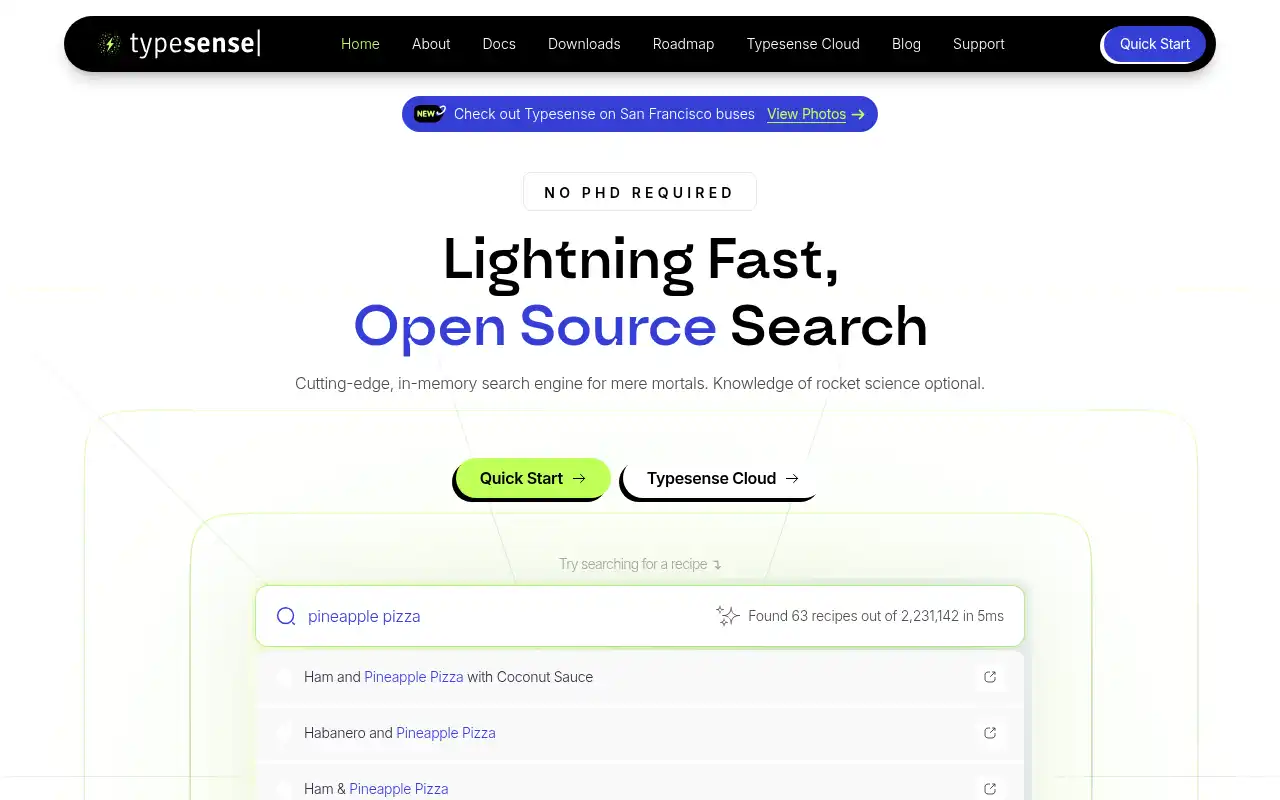
Typesense is Meilisearch's closest open-source competitor. It's a modern, typo-tolerant search engine written in C++ that keeps its entire index in RAM for sub-50ms responses. Where Meilisearch focuses on simplicity, Typesense leans into performance and offers resource-based pricing in its cloud offering, so you never pay per search request.
- Features: Typo tolerance, faceting, filtering, geo search, synonyms, curation, vector search, conversational search (RAG), federated multi-index search, join/reference across collections, and an InstantSearch UI adapter.
- Why You Should Use It: If you need high-volume search without per-query pricing surprises, Typesense is a great pick. Its resource-based cloud billing means traffic spikes don't blow up your bill. The built-in vector and conversational search features make it a strong choice for AI-powered search use cases.
- Why Not: Typesense requires all data to fit in RAM, which can get expensive for very large datasets. It has a smaller community and ecosystem than Meilisearch, and fewer SDKs and integrations out of the box.
- Pricing: Free tier with 720 hours of cluster time (about 30 days). Cloud starts at ~$7/month for a small cluster. No per-query charges. Self-hosting is completely free.
2. Algolia

Algolia is the SaaS search market leader, powering search for companies like Stripe, Slack, and Twitch. Unlike Meilisearch, Algolia is fully managed with no self-hosting option. It trades open-source flexibility for a polished, enterprise-grade experience with AI features like personalization, recommendations, and NeuralSearch.
- Features: InstantSearch UI libraries, AI-powered ranking and recommendations, A/B testing, analytics dashboard, personalization, query suggestions, merchandising tools, and 100+ integrations.
- Why You Should Use It: If you want best-in-class managed search without touching any infrastructure, Algolia delivers. The analytics, A/B testing, and merchandising features make it especially strong for e-commerce. Support and documentation are excellent.
- Why Not: Algolia's usage-based pricing scales aggressively. A mid-sized store with 500K monthly searches can easily hit $245/month or more. There's no self-hosting option, so you're locked into their platform. AI features require the more expensive Grow Plus or Premium plans.
- Pricing: Free Build tier (10K requests/month, 1M records). Grow plan charges $0.50/1K requests and $0.40/1K records. Grow Plus at $1.75/1K requests for AI features. Premium and Elevate require annual contracts with custom pricing.
3. Elasticsearch
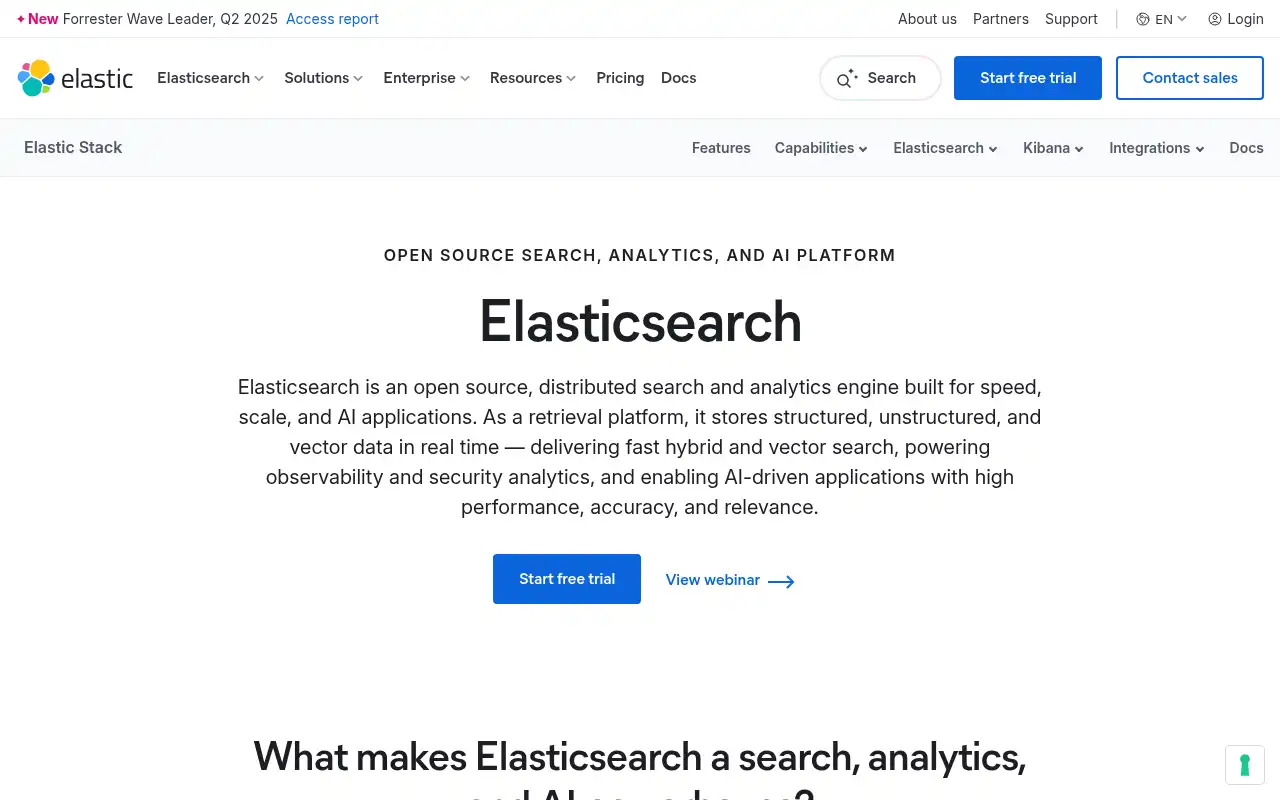
Elasticsearch is the heavyweight champion of search and analytics. It powers everything from site search to log analysis, APM, and SIEM. While Meilisearch is built specifically for front-facing, instant search, Elasticsearch is a general-purpose engine that handles complex aggregations, full-text search, and analytics across massive datasets.
- Features: Distributed architecture, full-text search with BM25 and vector search, complex aggregations, Kibana dashboards, machine learning anomaly detection, APM, log analytics, security analytics (SIEM), and a rich plugin ecosystem.
- Why You Should Use It: If your search needs go beyond a simple search bar, Elasticsearch is hard to beat. It handles analytics, logging, and observability alongside search. The Elastic Stack (ELK) is the industry standard for log management. If you need to search through millions of documents with complex filters and aggregations, this is your tool.
- Why Not: Elasticsearch is complex to operate and tune. It's overkill for a simple site search where Meilisearch shines. Resource consumption is significantly higher, and the learning curve is steep. The licensing situation (AGPL/ELv2/SSPL triple license) can be confusing.
- Pricing: Elastic Cloud starts at ~$99/month (Standard). Production deployments typically run $190-$210/month for 20 GB. Self-hosting the open-source version is free.
4. OpenSearch
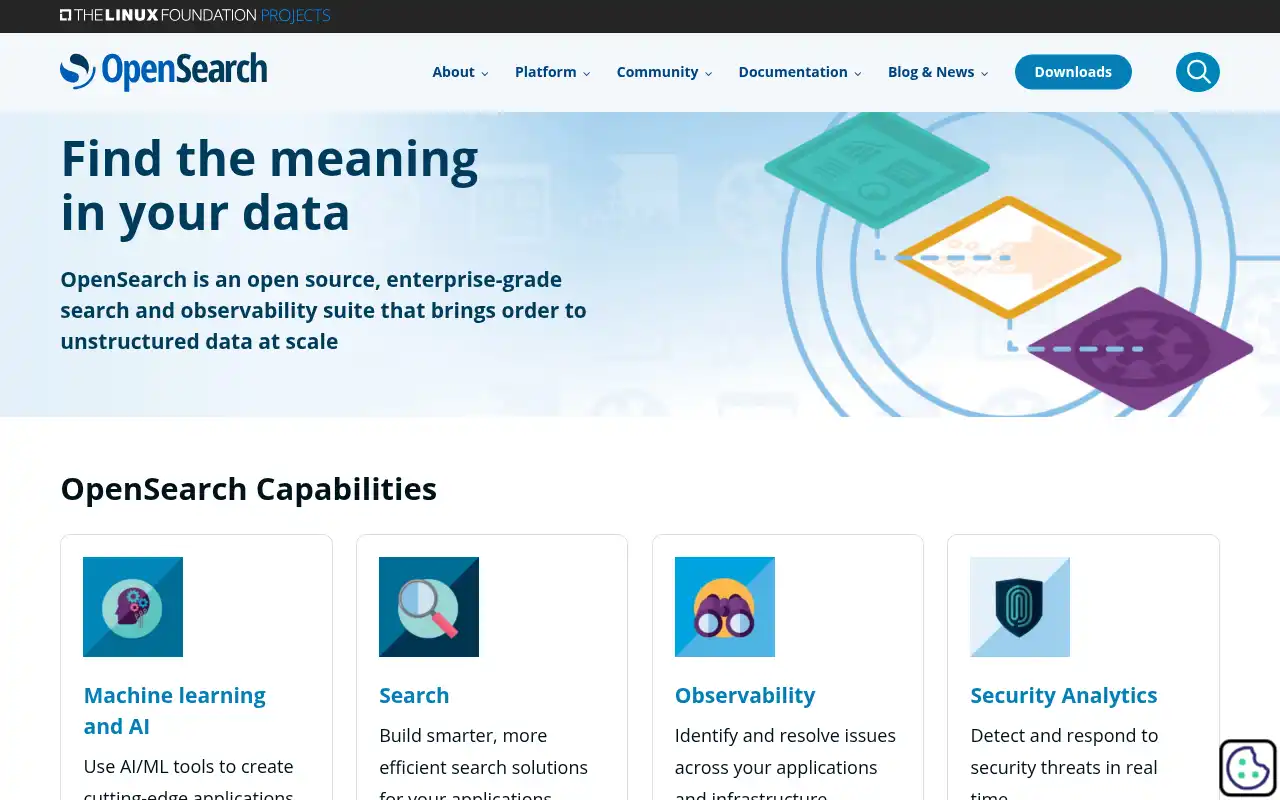
OpenSearch is the community-driven, Apache 2.0-licensed fork of Elasticsearch 7.10.2, created by AWS after Elastic changed their license. It provides a fully open-source search and analytics suite with OpenSearch Dashboards (a Kibana fork) included. If you want Elasticsearch-like power without licensing concerns, OpenSearch is your answer.
- Features: Full-text search, analytics, anomaly detection, security analytics, observability, k-NN vector search, SQL/PPL query support, alerting, index management, cross-cluster replication, and OpenSearch Dashboards for visualization.
- Why You Should Use It: If you need Elasticsearch-level functionality but want a truly open-source solution with no license strings attached, OpenSearch is the way to go. AWS backing means strong long-term support. The managed AWS service handles scaling, patching, and backups automatically.
- Why Not: OpenSearch trails Elasticsearch in some advanced features like ML-based anomaly detection and newer vector search capabilities. The community is smaller, and some third-party integrations still target Elasticsearch first. Migration from recent Elasticsearch versions can require work.
- Pricing: AWS managed clusters start at ~$26/month (t3.small). Serverless has a $700/month minimum (4 OCUs). The open-source version is free to self-host. AWS Free Tier includes 750 hours/month of t3.small.
5. Quickwit
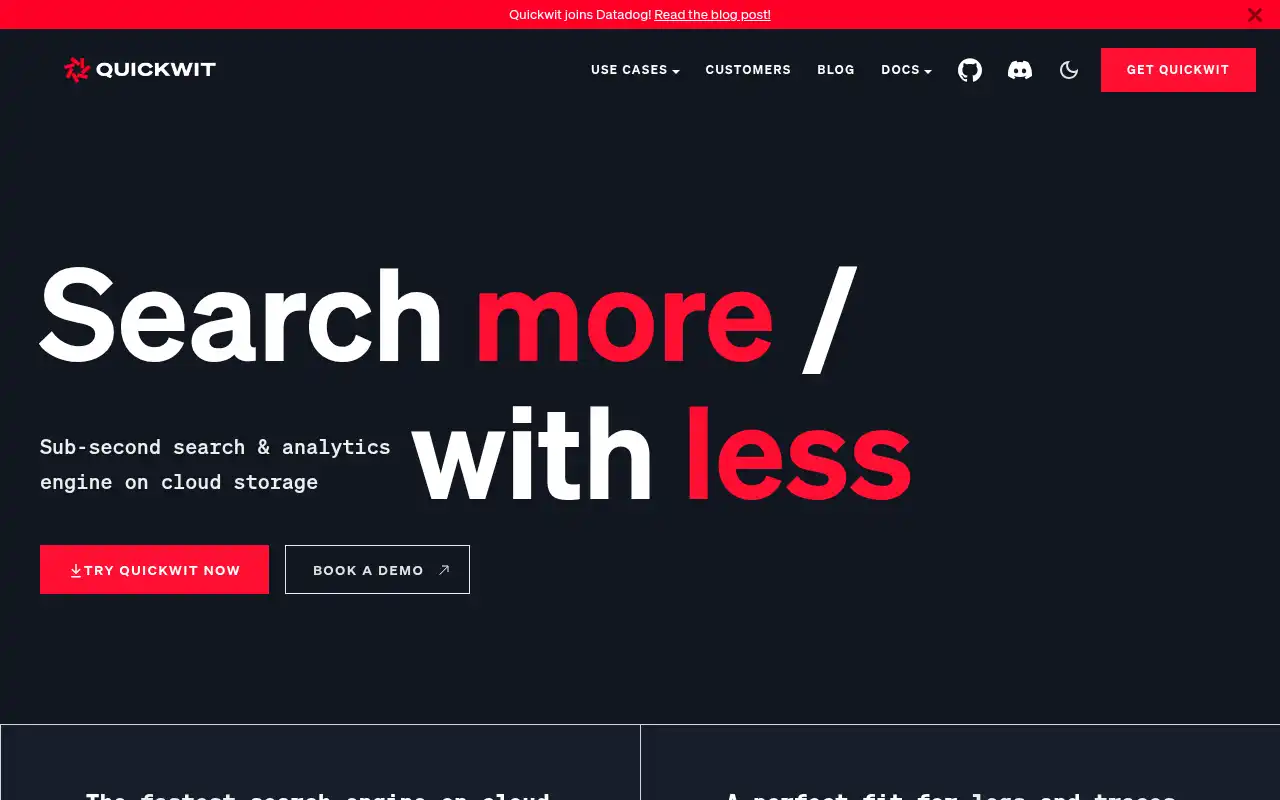
Quickwit is a cloud-native search engine built in Rust, designed specifically for log and trace data at massive scale. Unlike Meilisearch, which targets front-facing search, Quickwit indexes directly on object storage (S3, MinIO) and uses stateless compute, making it dramatically cheaper for large observability workloads.
- Features: Sub-second search on object storage, native OpenTelemetry support, Jaeger integration for distributed tracing, Kafka/Kinesis ingestion, schemaless indexing, Elasticsearch-compatible API, Grafana plugin, and horizontal scaling with stateless indexers and searchers.
- Why You Should Use It: If you're drowning in log data and your Elasticsearch bill is out of control, Quickwit can cut costs by up to 90%. Its architecture decouples storage from compute, so you only pay for S3 storage and the compute you actually use. Perfect for observability pipelines where you need to search petabytes of logs without breaking the bank.
- Why Not: Quickwit is purpose-built for logs and traces, not for front-facing site search or e-commerce. It doesn't have typo tolerance, instant search, or the developer-friendly features that make Meilisearch great for user-facing search. Datadog acquired Quickwit in early 2025, so future direction may shift.
- Pricing: Quickwit is fully open-source under the Apache 2.0 license. There is no managed cloud offering. You self-host and pay only for your infrastructure (compute + object storage). Claims up to 10x cheaper than Elasticsearch for log workloads.
Conclusion
| Tool | Best For | Ease of Setup | Focus | Cloud Pricing |
|---|---|---|---|---|
| Meilisearch | Simple site search, instant results | Very Easy | User-facing search | Cloud from $30/mo |
| Typesense | High-volume search, no per-query fees | Easy | User-facing search | Cloud from ~$7/mo |
| Algolia | E-commerce, enterprise managed search | Very Easy | Managed SaaS search | Pay-as-you-go from $0.50/1K req |
| Elasticsearch | Analytics, logging, complex queries | Moderate | General-purpose search | Elastic Cloud from ~$99/mo |
| OpenSearch | Open-source Elasticsearch alternative | Moderate | Search & analytics | AWS from ~$26/mo |
| Quickwit | Log search at massive scale | Moderate | Observability | Open-source (self-host only) |
Each tool fills a different niche: Typesense for high-throughput instant search without per-query costs, Algolia for fully managed enterprise search, Elasticsearch for analytics-heavy workloads, OpenSearch for a truly open-source Elasticsearch replacement, and Quickwit for cost-effective log search at petabyte scale.
Meilisearch remains the best choice for developers who want a dead-simple, instant search experience with minimal setup. But if your needs extend beyond a search bar into analytics, logs, or enterprise-scale e-commerce, one of these alternatives will serve you better.
If you want to self-host Meilisearch or Elasticsearch, check out these guides: